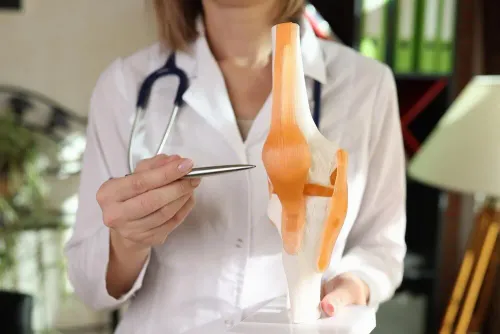

Knee arthritis deserves closer evaluation when pain, stiffness, deformity, or instability starts changing how far you walk, how you use stairs, or whether you can sleep comfortably. You will learn which symptoms need routine or prompt assessment, what a surgeon checks, how X-rays influence the decision, and when knee replacement becomes a reasonable discussion rather than an automatic recommendation.
Key takeaways
- Night pain, rest pain, deformity, and reduced walking distance warrant evaluation.
- Emergency care is needed after a hot, swollen knee with fever or sudden inability to bear weight.
- Compare exercise therapy, medicines, injections, braces, and surgery with your surgeon.
- Bring symptom history, treatment records, medication lists, and knee imaging to your consultation.
Which knee symptoms suggest that arthritis has become advanced?
Advanced knee arthritis symptoms usually form a pattern: pain while walking, difficulty climbing stairs with knee arthritis, swelling, stiffness after sitting, reduced bending or straightening, and a shorter walking distance. You may also struggle to stand from a chair, develop knee pain at rest or knee pain at night, or experience repeated giving way.
| Symptom pattern | Why evaluation matters |
|---|---|
| Pain with walking, stairs, rest, or sleep | Shows symptoms are affecting daily function or recovery |
| Persistent swelling and stiffness after sitting | Suggests ongoing joint inflammation and loss of comfortable movement |
| Reduced range of motion or difficulty rising from a chair | Indicates functional loss beyond occasional discomfort |
| Repeated giving way | May reflect ligament insufficiency or a mechanical problem |
| Fixed bowing or knock-kneed alignment | Can signal progressive joint damage and affect treatment planning |
Arrange a knee-replacement evaluation when these problems persist or worsen, especially when they limit work, household tasks, walking, stairs, or sleep. Manageable pain does not make declining function unimportant. The threshold is continuing interference with ordinary activities, not an arbitrary age cutoff.
These symptoms do not prove that replacement is needed. Hip disease, lumbar nerve compression, meniscal or ligament problems, inflammatory arthritis, and referred pain can imitate knee arthritis, so examination and imaging must confirm the source. Clicking or grinding alone is not a reason for replacement.
When is knee arthritis routine, prompt, or an emergency problem?
Arrange a routine orthopedic evaluation when knee symptoms continue for several weeks, return despite activity changes, or gradually reduce walking, work, sleep, or household tasks. These knee arthritis warning signs matter even when pain remains manageable; declining function often signals a problem worth assessing.
1. Routine: Book an appointment if stiffness after sitting, swelling, reduced motion, stair difficulty, or a shorter walking distance persists. Do not wait for pain to become severe.
2. Prompt: Seek assessment sooner when function worsens quickly, the knee repeatedly gives way, swelling does not settle, motion is becoming fixed, or pain is no longer controlled by a reasonable nonsurgical plan.
3. Urgent: Obtain same-day medical assessment for a hot swollen knee with fever or chills, rapidly worsening pain, a sudden inability to bear weight, or a locked knee after injury. A recent wound or procedure increases concern.
Infection, crystal arthritis such as gout, fracture, and other acute conditions can resemble an osteoarthritis flare. Treating these as routine arthritis can delay time-sensitive care. Night or rest pain also deserves evaluation when it accompanies functional decline, but it does not prove that replacement is needed.
There is no universal rule requiring you to wait three or six months before arranging review. Progressive symptoms, repeated instability, or meaningful loss of walking and daily function justify earlier assessment.
What happens during a knee replacement evaluation?
The decision is based on disability, examination, and imaging—not the phrase “bone-on-bone” alone. The surgeon takes a symptom timeline and asks how far you walk, whether stairs or rising from a chair are difficult, whether pain interrupts sleep, and which treatments have failed.
They assess gait, leg alignment, knee range of motion, ligament stability, muscle strength, swelling, and possible hip, spine, or foot sources of pain. Severe X-ray changes do not mandate surgery; major disability can justify assessment despite less dramatic images.
Expect questions about:
- Your walking distance and whether pain limits work or household activities
- Stairs, chair transfers, stiffness after inactivity, and episodes of giving way
- Previous medicines, therapy, injections, activity changes, and the relief each provided
| Imaging | What it shows | How it affects the decision |
|---|---|---|
| Standing weight-bearing knee X-ray | Joint-space loss and varus or valgus alignment under load | Usually the key initial image |
| Advanced osteoarthritis | Bone-on-bone knee arthritis, osteophytes and subchondral sclerosis | Supports the diagnosis but does not alone require replacement |
| MRI | Menisci, ligaments, cartilage, or another suspected condition | Not routinely needed for typical end-stage osteoarthritis or routine replacement planning; use it when the history or examination suggests another problem |
Which treatments should you compare before discussing knee replacement?
Judge non-surgical treatment for knee arthritis by two outcomes: does it reduce pain enough for useful daily activity, and does that benefit last? Failure of one treatment does not prove that replacement is inevitable.
| Option | What it may improve | Important limit |
|---|---|---|
| Weight reduction, when appropriate | Load on the knee and walking tolerance | It is not a prerequisite for evaluation |
| Activity modification | Pain triggered by stairs, squatting, or high-impact exercise | Avoiding activity altogether causes weakness |
| Strengthening and physical therapy for knee arthritis | Muscle support, balance, range of motion, and function | Progress requires regular practice |
| Cane or other walking aid | Stability and weight distribution | Incorrect height or use can increase strain |
| Topical diclofenac or oral pain and anti-inflammatory medicine | Pain and inflammation | Check kidney, stomach, heart, blood-pressure, and bleeding risks |
| Selected injections | Temporary symptom relief | A corticosteroid does not restore cartilage |
| Treating hip, spine, or foot problems | Pain caused or amplified outside the knee | Knee replacement will not fix a different pain source |
Tell the surgeon about every knee injection before replacement. An injection within roughly three months before total knee replacement has been associated with higher infection risk, so timing affects planning.
A replacement discussion becomes reasonable when radiographic arthritis combines with persistent pain, substantial functional loss, and inadequate durable relief after an appropriate trial. You do not need to complete every option for a fixed number of months.
Obesity, diabetes, smoking, anemia, poor dental health, or uncontrolled disease call for knee replacement medical optimization, not automatic exclusion.
How should you prepare for a knee replacement consultation?
Bring enough detail to show how the knee affects your life, not just how it looks on an X-ray. Use this checklist to prepare for knee replacement consultation:
- Symptom timeline, including worsening pain, swelling, stiffness, and giving way
- Current walking limit and examples of difficult stairs or chair transfers
- Sleep disruption and pain at rest
- Previous treatments, their duration, and results
- Complete medication list, allergies, and medical conditions
- Prior imaging and reports
- Records of every recent injection, including its date and type
Use these questions to guide the appointment:
| Question | Why it matters |
|---|---|
| Is the knee the main pain source? | Hip, spine, foot, or nerve problems can imitate knee pain. |
| Which nonsurgical options remain worthwhile? | A useful treatment may still avoid or delay surgery. |
| How do examination findings match the X-rays? | Disability, alignment, motion, and imaging must tell the same story. |
| If surgery is discussed, what implant and hospital stay fit me? | Choice and discharge planning depend on health, bone, and support at home. |
| How will you reduce blood-clot, infection, stiffness, and persistent non-knee pain risks? | These risks affect preparation and expectations. |
| When can I drive, work, and manage stairs, and what is the knee replacement recovery timeline? | Arrange transport, leave, home support, and rehabilitation early. |
Dr. Girish Motwani Best Orthopedic Surgeon - SUYOG can provide a knee replacement evaluation in Nagpur that connects symptoms, examination, imaging, and treatment choices. Tolerable pain with acceptable function supports waiting; persistent disability deserves review regardless of age or one reassuring X-ray label.
Frequently asked questions
Which symptoms suggest that knee arthritis has become advanced?
Pain during walking, stairs, or chair transfers; swelling; stiffness after sitting; reduced knee movement; shorter walking distance; rest or night pain; and repeated giving way suggest advanced arthritis that deserves evaluation.
When is knee arthritis an emergency problem?
Seek urgent care for a hot, swollen knee with fever, sudden inability to bear weight, severe pain after an injury, a visibly deformed joint, or a cold, pale, numb foot.
What happens during a knee replacement evaluation?
The surgeon reviews your symptoms, walking limits, medical history, medicines, previous treatments, and imaging, then examines alignment, swelling, stability, strength, and knee movement before discussing options.
Which treatments should you compare before discussing knee replacement?
Compare exercise-based physiotherapy, weight management when appropriate, pain medicines, topical anti-inflammatory gels, braces or walking aids, corticosteroid injections, and other injections with their benefits and limitations.
How should you prepare for a knee replacement consultation?
Record pain triggers, walking distance, night symptoms, swelling, falls, and prior treatments. Bring medication details, medical records, imaging reports and scans, and a list of questions.