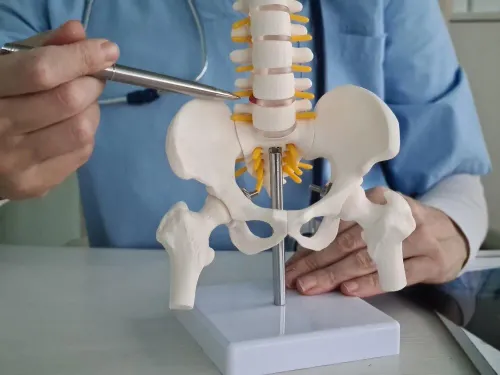

Shoulder pain that lasts beyond a short episode, returns repeatedly, disrupts sleep, or limits lifting deserves more than indefinite home care. You will learn how to judge urgency, distinguish common pain patterns, prepare for an examination, and understand when X-ray, ultrasound, or MRI can help.
Key takeaways
- Pain lasting over two weeks warrants a shoulder evaluation.
- Seek urgent assessment after injury, with deformity, numbness, or chest symptoms.
- Recurring pain with reaching or sleeping can indicate a tendon or joint problem.
- Bring your symptom timeline, injury details, treatments, and medication list.
What Counts as Persistent Shoulder Pain?
Shoulder pain lasting more than two weeks deserves an evaluation, especially when it limits dressing, reaching overhead, work, or sleep. Persistent shoulder pain does not have to be continuous: recurrent shoulder pain that keeps returning after activity, rest, or treatment also counts.
Severe pain after a fall, progressive weakness, or loss of movement warrants earlier assessment rather than waiting for the two-week mark.
| Pattern | What it may suggest | Why evaluation helps |
|---|---|---|
| Pain with lifting, but passive movement remains fairly normal | Rotator-cuff or tendon problem | Examination can separate weakness from pain-limited effort |
| Pain with restricted active and passive movement, especially external rotation | Frozen shoulder | Recovery often takes months, not days |
| Grinding, stiffness, and pain during movement | Arthritis | An examination can determine whether joint changes matter |
| Pain after repeated overhead use | Bursitis or tendonitis | Activity changes and targeted treatment may prevent persistence |
| Shoulder slipping, clicking, or repeated “dead arm” episodes | Instability or labral injury | Recurrent episodes can worsen without stabilisation advice |
| Neck pain with tingling, numbness, or pain below the elbow | Referred neck or nerve-related pain | The shoulder may not be the primary source |
Night shoulder pain is common in rotator-cuff disorders but does not prove a tear. Seek prompt medical care for pain with fever, a hot swollen joint, sudden major weakness, or an injury that leaves the shoulder visibly deformed or the arm unusable.
Chest pressure, breathlessness, sweating, nausea, or pain spreading to the jaw or arm requires emergency assessment.
When Shoulder Pain Needs Urgent Assessment
Chest pressure, breathlessness, sweating, nausea, or pain spreading from the shoulder to the jaw or arm requires emergency assessment, especially with left-shoulder pain. The source may be the heart, lungs, neck, or diaphragm rather than the shoulder itself. Do not drive yourself if you feel faint, severely unwell, or short of breath.
| Symptom | Action | Why it matters |
|---|---|---|
| Chest pressure, breathlessness, sweating, nausea, or pain spreading to the jaw or arm | Seek emergency care now | Shoulder pain can be referred from the heart or lungs |
| Deformed shoulder after injury, or a shoulder that looks out of place | Seek same-day emergency assessment | A fracture or dislocation may need prompt reduction or immobilisation |
| Inability to lift arm after trauma, sudden major weakness, or rapidly worsening function | Seek same-day assessment | This can indicate fracture, tendon disruption, or nerve injury |
| Hot swollen shoulder joint with fever, marked redness, or feeling systemically ill | Seek same-day assessment | Infection can damage the joint and requires urgent treatment |
| Numbness, a pale or blue hand, a cold arm, or a weak pulse | Seek emergency care now | Nerve or blood-vessel compromise threatens arm function |
These are shoulder pain red flags, not symptoms to monitor through home exercises. Lower your threshold for urgent care if you have diabetes, immune suppression, recent shoulder surgery or injection, or intravenous drug use. Never try to “pop” a first-time dislocation back into place.
What the Pain Pattern Can Suggest
Pain location and movement often narrow the cause, but they cannot confirm it alone. The key comparison is whether the shoulder is weak, stiff, unstable, or painful only during specific actions. Shoulder bursitis and tendonitis can overlap, so examination matters.
| Pattern | Clues that point toward it |
|---|---|
| Rotator cuff injury | Rotator cuff injury symptoms include pain lifting the arm, reaching overhead, or lying on that side. Weakness with active movement and relatively preserved passive movement suggest tendon damage; night pain is common but not diagnostic. |
| Frozen shoulder | Frozen shoulder symptoms include gradual pain and stiffness with loss of both active and passive movement, especially external rotation. You may struggle to reach behind your back. |
| Shoulder arthritis | Shoulder arthritis causes a deep ache, progressive stiffness, and grinding or clicking. Both active and passive movement become painful. |
| Bursitis | Bursitis causes pain over the outer shoulder, often worse when lying on it or raising the arm through a particular arc. Strength is usually normal when pain is not limiting effort. |
| Tendonitis | Tendonitis causes pain during resisted movement, such as lifting or rotating the arm, without a clear loss of passive range. |
| Instability | Instability feels like slipping, giving way, or the shoulder partially coming out, often after an injury or in extreme positions. |
| Labral injury | A labral injury can cause deep pain, catching, clicking, or a feeling of locking after a fall, traction injury, or throwing. |
| Referred neck pain | Neck-related pain may extend into the shoulder blade or arm and change when you turn or bend your neck. |
| Nerve-related pain | Burning or electric pain with tingling, numbness, or weakness down the arm points toward nerve involvement rather than an isolated shoulder tendon. |
Chest pressure or breathlessness with shoulder pain requires emergency assessment, not a routine shoulder evaluation.
When to Book a Shoulder Specialist and How to Prepare
Book a shoulder specialist when pain continues despite a well-followed home or physiotherapy program, limits work or sleep, or leaves you unsure of the diagnosis.
Do not wait for routine care after a significant injury, progressive shoulder weakness, inability to lift the arm, or suspected recurrent shoulder dislocation; a visibly deformed shoulder or sudden loss of movement needs urgent assessment.
- Continue home care when symptoms are mild, movement is improving, and you have no trauma, weakness, numbness, fever, or functional loss.
- See a general doctor or physiotherapist first for stable pain without red flags, especially when guided exercise has not yet been tried. A specialist becomes the better next step when therapy worsens symptoms, fails to restore function, or the examination suggests a tear, instability, frozen shoulder, arthritis, or referred neck pain.
- Book directly with a shoulder specialist after a major injury, repeated dislocations, worsening weakness, marked loss of motion, or persistent night pain combined with weakness or reduced function. Night pain alone does not prove a tear.
- Bring the injury date, pain locations, movements you cannot perform, medication list, prior treatment, and any X-rays or reports. During the shoulder specialist examination, expect questions about your neck and symptoms, active and passive movement tests, strength testing, and checks for instability, sensation, and circulation.
- Ask what each test would change before requesting an MRI. Dr. Girish Motwani Best Orthopedic Surgeon - SUYOG can use the examination to decide whether an X-ray, ultrasound, MRI, or nonsurgical treatment is the useful next step.
Related services
Orthopedic Doctors Orthopaedic all orthopedic services available |
Orthopedic all xray View service → |
How Clinicians Choose X-Ray, Ultrasound, or MRI
Imaging is chosen to answer a specific clinical question, not simply because shoulder pain has lasted a long time. Examination findings, injury history, movement limits, weakness, and response to initial treatment determine whether a scan is useful.
| Test | What it can show | How the result affects treatment |
|---|---|---|
| Shoulder X-ray | Fracture, arthritis, dislocation, bone spurs, joint-space loss, or calcific deposits | Usually the initial study for persistent pain; it may support exercise-based care, injections, or further soft-tissue imaging |
| Shoulder ultrasound | Rotator-cuff tendons, bursitis, fluid, tendon movement, and some tears | Helps assess suspected tendon disease and can guide an injection; findings must match weakness and pain |
| Shoulder MRI | Tear location and size, tendon retraction, muscle quality, labrum, cartilage, bone marrow, and other soft tissues | Helps plan treatment when surgery or a more specific diagnosis is being considered |
A normal X-ray can occur with a rotator cuff tear because radiographs show bones, not most tendons or bursae. Ultrasound or MRI can reveal those problems, but both can also show age-related tears in people without symptoms.
Persistent pain does not automatically justify a shoulder MRI. If examination and X-ray suggest a soft-tissue problem, order ultrasound or MRI when the result could change treatment.
A confirmed tear does not automatically mean surgery. Activity modification, supervised exercises, and medically safe pain relief often come first; surgery becomes more relevant with traumatic weakness, major functional loss, persistent symptoms despite rehabilitation, or a repairable tear that fits the person’s age, tissue quality, activity, and goals.
Frequently asked questions
When does shoulder pain count as persistent?
Shoulder pain counts as persistent when it lasts more than two weeks or repeatedly returns after activity, rest, or treatment.
When does shoulder pain need urgent assessment?
Seek urgent assessment after a major injury, visible deformity, sudden weakness, numbness, a cold or pale arm, fever with a hot swollen joint, or shoulder pain with chest pressure or breathlessness.
What can the pattern of shoulder pain suggest?
Pain with overhead movement can suggest a tendon or bursa problem; night pain and stiffness can point toward rotator-cuff or frozen-shoulder conditions. Pain that travels below the elbow can come from the neck rather than the shoulder.
When should you book a shoulder specialist?
Book a shoulder specialist when pain lasts over two weeks, limits dressing, reaching, work, or sleep, keeps returning, or fails to improve with appropriate self-care.
How do clinicians choose between an X-ray, ultrasound, and MRI?
X-rays show bones, joint space, arthritis, and fractures. Ultrasound assesses moving tendons and fluid near the joint. MRI provides detailed views of rotator-cuff tears, cartilage, labrum, bone marrow, and other soft tissues.
Related service
General Consultation ₹700 General Consultation |