Knee pain after a twist, swelling after activity, or a locking sensation does not prove that surgery is needed. You will learn how to distinguish a meniscus tear from other knee injuries, recognise symptoms that need prompt assessment, and understand when monitoring, rehabilitation, repair, or partial meniscectomy becomes the more appropriate path.
Key takeaways
- Joint-line pain with twisting, squatting, or stairs supports a meniscus problem.
- Tear location and blood supply help determine whether repair is possible.
- Seek urgent assessment for a locked knee, severe swelling, or inability to bear weight.
- Recovery depends on the treatment chosen and the tear’s location and extent.
What the Meniscus Tear Is—and Which Symptoms Matter
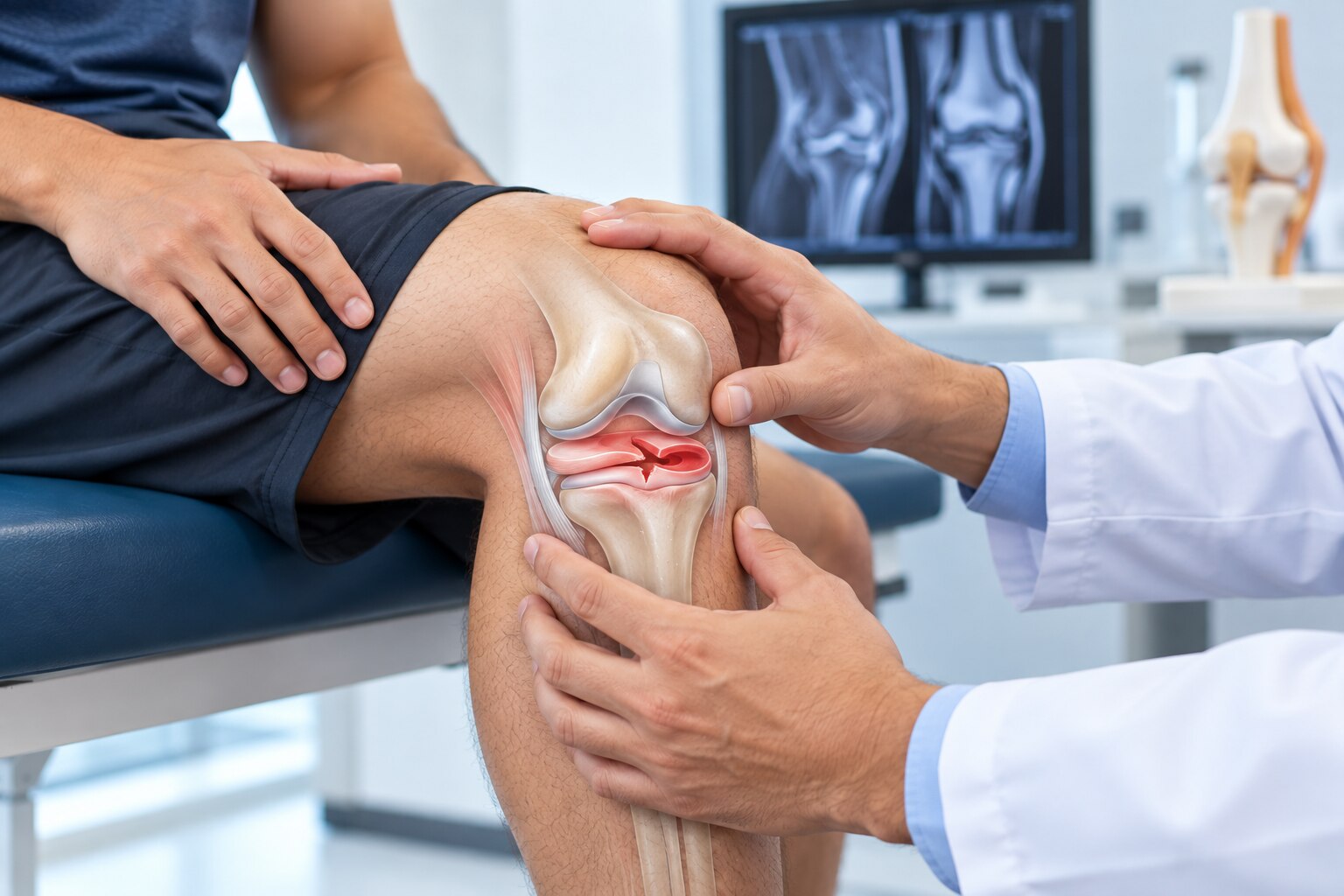
A meniscus tear is more likely when pain sits directly along the inner or outer joint line and worsens with twisting, squatting, or climbing stairs. Knee swelling after activity, catching, difficulty fully straightening the knee, and tenderness when the joint line is pressed also support a meniscus problem.
The mechanism matters. A planted-foot twist followed by a pop, rapid swelling, and immediate instability raises concern for an ACL injury, especially when the knee repeatedly gives way. ACL pain is less precisely located at the joint line.
Articular cartilage damage can cause deep aching, swelling, catching, or grinding without the clear joint-line tenderness of a meniscus tear. Kneecap disorders usually cause pain at the front of the knee, particularly with stairs, running, prolonged sitting, or kneeling.
| Pattern of symptoms | More consistent with | What can mislead you |
|---|---|---|
| Joint-line pain, twisting pain, catching, activity-related swelling | Meniscus tear | An MRI finding may be incidental, especially with age |
| Pop, rapid swelling, repeated giving way | ACL injury | A meniscus tear can occur alongside an ACL injury |
| Deep pain, grinding, swelling, catching | Articular cartilage damage | Meniscal and cartilage symptoms can overlap |
| Front-of-knee pain with stairs, sitting, or kneeling | Kneecap disorder | Pain location can shift when several problems coexist |
MRI can show a meniscus tear, but it cannot prove that the tear causes your symptoms. Examination findings, knee motion, swelling, injury history, and your activity goals must match the scan before treatment decisions follow.
Why Tear Pattern and Blood Supply Affect Repair
A vertical longitudinal tear in the outer, well-vascularised meniscus is among the most repairable patterns. Blood vessels reach this peripheral “red-red” zone, allowing healing after the edges are stitched; the inner free edge has little blood supply and heals poorly.
Tear pattern still matters. A bucket-handle tear is a displaced longitudinal tear that may be repairable when the fragment is viable and the knee is stable, but a fragment blocking full extension needs prompt assessment.
A radial tear cuts across the circumferential fibres that carry load, so repair depends heavily on its distance from the vascular rim and its size. A horizontal tear, flap tear, or complex, crushed tear often has weaker healing potential, although a surgeon may repair selected tears in healthy tissue rather than remove them.
| Tear pattern | Repair is more plausible when | Why location matters |
|---|---|---|
| Longitudinal tear | It runs vertically in the peripheral meniscus | The outer rim has better blood flow |
| Bucket-handle tear | The displaced fragment remains healthy and can be reduced | A stable repair may restore the meniscus; a locked knee needs prompt review |
| Radial tear | It is small or reaches vascular tissue | The inner portion has limited healing capacity |
| Horizontal tear | It is traumatic, symptomatic, and has repairable tissue | Degenerative inner splits often heal poorly |
| Flap tear | The flap is stable and tissue quality is good | An unstable inner flap is often irreparable |
An MRI tear alone does not decide treatment. Symptoms, examination findings, tissue quality, knee stability, and activity goals determine whether repair offers more benefit than trimming.
When a Torn Meniscus Needs Urgent Assessment or Active Treatment
A locked knee or sudden reduced knee extension needs prompt assessment, especially after an injury. Seek urgent care if you cannot bear weight, the knee becomes rapidly and markedly swollen, or it is hot and red with fever; these signs need more than routine meniscus advice.
For an acute tear without locking, start with activity modification, ice for short periods, pain treatment recommended for you, and supervised exercises that restore motion and strength. Avoid twisting, deep squats, and pivoting until symptoms settle. Giving way, persistent swelling, or difficulty squatting or climbing stairs warrants clinical review rather than self-treatment alone.
Use the pattern below as a decision guide:
- Monitor symptoms when pain is mild, knee motion is full, swelling is absent, and daily activities remain comfortable. An MRI tear alone does not justify surgery, particularly as meniscal changes become common with age.
- Try supervised rehabilitation when symptoms limit activity but the knee is not locked. Improvement after a structured programme supports continued non-operative care; failure to improve supports a surgical consultation, with timing tailored to the tear and your goals.
- Discuss meniscus repair for a symptomatic, repairable tear, recurrent locking, or a meniscal root tear. Repair preserves tissue but can require restricted weight bearing or knee flexion for weeks and a return to pivoting sports after several months.
- Discuss partial meniscectomy when an unstable fragment causes symptoms and the tissue cannot be durably repaired. Trimming often recovers faster, but removing tissue increases contact stress and long-term cartilage risk.
How Clinicians Confirm Whether the Tear Is Causing the Problem
An MRI finding requires treatment only when it matches the patient’s symptoms, examination, tear pattern, activity goals, and response to initial care. Clinicians establish that connection from four sources:
- Injury history: A twist, squat, collision, or sudden swelling supports an acute tear. Gradual pain without a specific injury points toward age-related change or another knee problem.
- Knee examination: Joint-line tenderness, swelling, painful catching, and loss of extension matter. Range-of-motion testing shows whether the knee is merely sore or physically blocked.
- Stability tests: These help separate meniscal symptoms from an ACL, posterior cruciate ligament, or collateral ligament injury. A stable knee strengthens the case for an isolated meniscus problem.
- Plain X-ray: It does not show the meniscus, but it reveals fracture, arthritis, bone alignment, or narrowed joint space that could explain the pain or change the treatment plan.
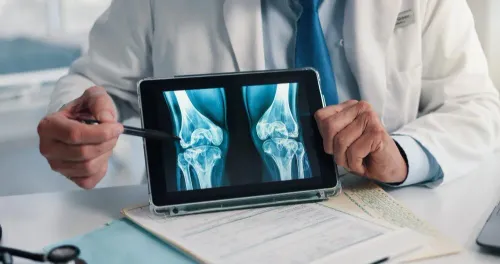
- MRI for meniscus tear evaluation: MRI defines the tear’s position, shape, displacement, and blood-supply zone. It also shows cartilage, ligament, bone, and root damage, but an abnormal scan alone does not justify surgery.
Meniscal abnormalities become more common with age, so clinicians compare the scan with the painful side and the examination rather than treating the image. Without a locked knee, an acute tear often receives activity modification, progressive exercises, and swelling control first.
Persistent symptoms after properly supervised rehabilitation support a surgical consultation; no single number of weeks applies to every tear.
When to Consult a Meniscus Repair Surgeon—and What Recovery Involves
Consult a meniscus repair surgeon when MRI and examination show a displaced tear, recurrent locking, loss of full extension, a meniscal root tear, persistent joint-line pain or swelling despite supervised rehabilitation, or symptoms in an unstable knee.
A consultation is also sensible when the report says the tear reaches the vascular zone, where healing potential is better.
- Ask whether the tissue is repairable, not simply whether it can be removed.
- Ask how long you will use crutches and whether flexion or weight bearing will be restricted.
- Ask what finding would indicate repair failure, especially renewed locking or ongoing joint-line pain.
Because the meniscus is a knee structure, Dr. Girish Motwani Best Orthopedic Surgeon - SUYOG is relevant to this decision only if the clinician assessing you routinely performs knee arthroscopy and meniscal repair; a foot-and-ankle focus alone does not establish that expertise.
| Option | Recovery | Long-term trade-off |
|---|---|---|
| Meniscus repair | Often several weeks of protected weight bearing or limited flexion; pivoting sports commonly require several months | Preserves cushioning and lowers the concern about increased cartilage stress, but healing can fail and rehabilitation is longer |
| Partial meniscectomy | Usually faster walking and return to everyday activity; fewer restrictions | Removes damaged tissue when repair is impossible, but greater tissue loss increases contact stress and long-term cartilage-degeneration risk |
A repair is less dependable in severely macerated, complex, or degenerative tissue, while a stable vertical tear in healthy tissue is more favourable. Reassess recurrent locking or persistent pain instead of treating them as normal recovery.
Frequently asked questions
What symptoms suggest a torn meniscus?
Pain directly along the inner or outer joint line, swelling after activity, catching, tenderness, and difficulty fully straightening the knee suggest a meniscus problem.
Why do tear pattern and blood supply affect meniscus repair?
The tear’s pattern and location determine whether the damaged tissue can heal. Areas with better blood supply have a stronger chance of healing after repair.
When does a torn meniscus need urgent assessment?
Seek urgent assessment when the knee locks, you cannot fully straighten it, swelling is severe, or you cannot bear weight safely.
How do clinicians confirm whether a meniscus tear is causing symptoms?
Clinicians combine your injury history, symptom pattern, joint-line examination, movement tests, and imaging when needed to identify the tear and other causes of knee pain.
What does recovery after meniscus treatment involve?
Recovery depends on whether the tear receives non-surgical care, repair, or another procedure. Rehabilitation focuses on restoring movement, strength, walking, and safe return to activity.